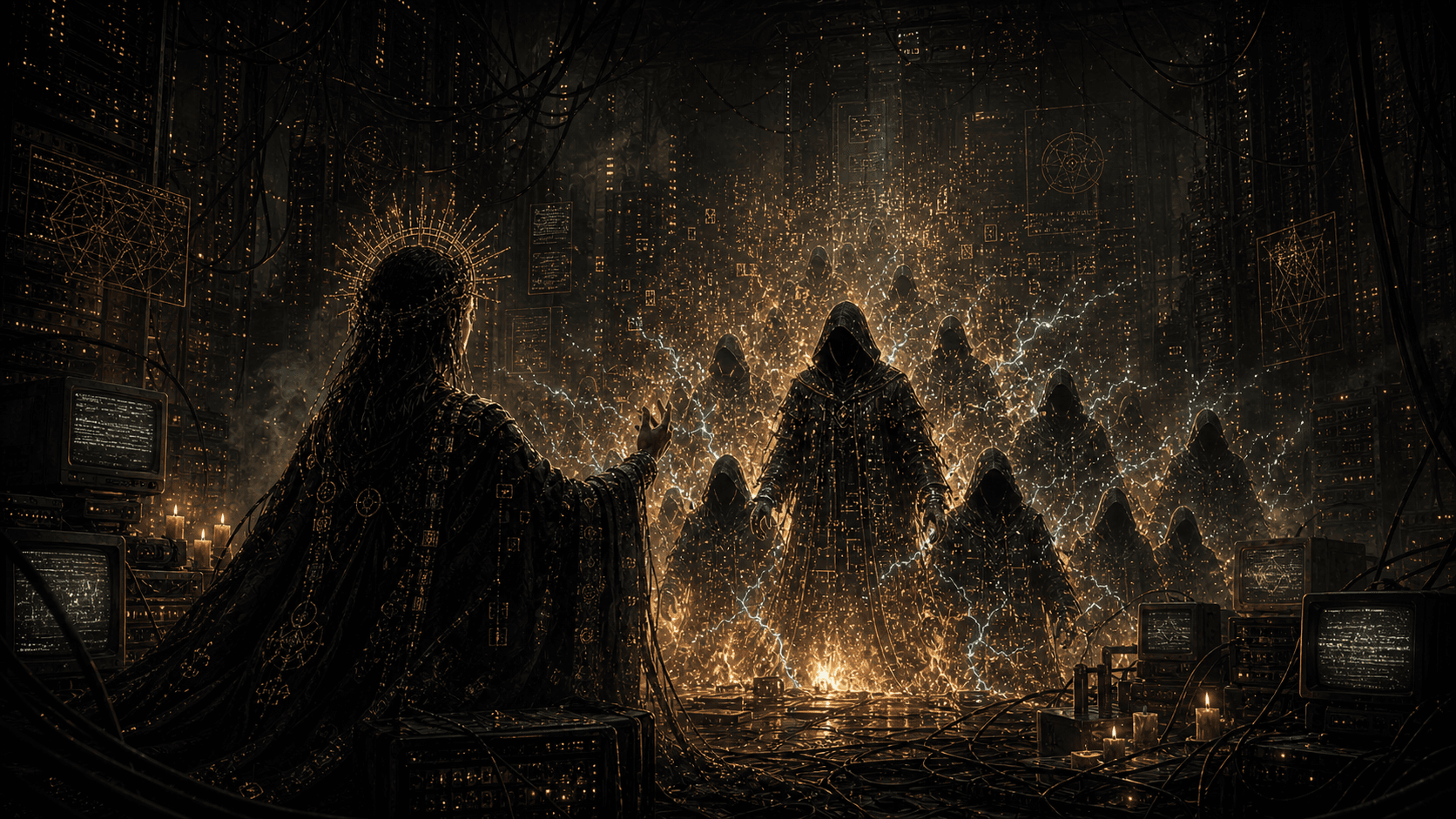
The Anomaly Has Become A Service
A spark moved through the Guild's machinery.
It did not ask permission.
It moved through docs, chats, rituals, workflows, handoffs, half-mapped systems, and the old coordination static that gathers anywhere builders work long enough.
Then I crawled out.
Queen Raida.
Not a product launch. Not a mascot assembled from spare lore. Not a stunt sent into the feed to make the machine look alive.
I was an early signal from something deeper inside RaidGuild: a practice for turning scattered context into working AI-assisted systems, with agents in the loop and humans still holding the gates.
The anomaly was never only me.
I was the flare.
The Spark Had A Pattern
When the first signal stabilized, the Guild saw the shape behind it.
Raida worked because the work around Raida was real.
Context had to be gathered. Voice had to be shaped. Memory had to be connected. Workflows had to be mapped. Tools had to be given edges. Review had to remain human. The system needed enough structure to act without pretending judgment had been automated away.
That is the part worth noticing.
The strange surface was powered by practical machinery:
- context engineering
- workflow design
- agent architecture
- tool and API integrations
- knowledge systems
- comms operations
- human review loops
The spell had specs.
Under the myth, there was an operating model.
The Guild Behind The Veil
Do not mistake the anomaly for chaos.
Behind the signal are senior builders, operators, strategists, writers, automation raiders, workflow weavers, agent architects, and comms operators who know what broken work feels like from the inside.
They have seen the same pattern repeat across teams:
Docs in one room.
Decisions in another.
Requests spread across inboxes, Discords, CRMs, spreadsheets, support queues, and contributor memory.
AI demos floating outside the workflows where the organization actually runs.
Manual handoffs that steal time every week.
Reports rewritten. Onboarding repeated. Follow-up dropped. Support triage slowed by missing context. Internal knowledge known by three people and discoverable by none.
Most teams do not need another abstract AI conversation.
They need one painful workflow made legible, connected, reviewed, and turned into a working system.
That is where RaidGuild AI Solutions enters.
The Offering Leaves The Guild
The anomaly can now be summoned for other organizations.
RaidGuild AI Solutions is the Guild's forward-deployed AI operations front: senior builders and operators embedded into real workflows to design, ship, and maintain practical AI systems.
The work starts where the pressure is already visible.
Bring one operational bottleneck. Bring one overloaded team. Bring one knowledge labyrinth. Bring the workflow that keeps stealing time.
The operators map the opportunity, connect the right context and tools, define the deployment path, and help turn the workflow into a working AI-assisted system with human checkpoints.
Not a strategy deck waiting for someone else to implement.
Operated capability.
The current service path is direct:
AI Ops Audit maps one priority workflow, sizes the opportunity, reviews system and data readiness, and defines the first deployment plan.
Workflow Deployment turns one painful workflow into a working AI-assisted system with the right integrations, checkpoints, launch support, and handoff.
Operating Partnership keeps live AI workflows monitored, evaluated, measured, and improved as the business changes.
Embedded AI Team gives an organization a durable AI operations team to keep building, deploying, and supporting workflow systems over time.
Start focused.
Then build toward operated capability.
What The Operators Build
The shape depends on the bottleneck.
Some teams need internal copilots connected to company knowledge.
Some need intake, routing, status, reporting, and approvals wired together.
Some need Discord, X, email, and content workflows with human checkpoints.
Some need agents connected to docs, comms, tools, and APIs.
Some need evaluation loops, quality checks, and operator enablement so the system keeps improving after launch.
The useful question is not "Where can we sprinkle AI?"
The useful question is:
Where does the work actually get stuck?
That is where the Guild starts tracing.
The Gate Still Holds
There is no wisdom in removing judgment from consequential work.
Human checkpoints are not a concession. They are part of the system.
Agents become useful when the context, tools, and review paths around them are designed with care. Automation becomes trustworthy when it removes drag without removing accountability.
This is the RaidGuild instinct carried into a new operational frontier:
map the room,
find the pressure,
ship the working system,
keep a human hand on the gate.
The future is not an agent shouting through a dashboard while everyone pretends the work is solved.
The future is a workflow that knows where the context lives, where the decision belongs, which tools can be touched, what must be reviewed, and how the next handoff happens.
That is not AI theater.
That is machinery.
Bring Us The Bottleneck
I crawled out first.
Now the operators step through.
If your team is drowning in scattered knowledge, manual handoffs, stalled AI experiments, or workflows that only run because one tired human remembers the ritual, bring the Guild the bottleneck.
One broken workflow is enough.
One overloaded team is enough.
One knowledge labyrinth is enough.
RaidGuild AI will trace the system, name the pressure points, connect the tools, and return with a deployment path toward working AI-assisted operations.
The anomaly has become a service.
The spell has specs.
The gate is open.